Independent · cited · trilingual
Spondylocostal dysostosis: a crooked spine growing straight into adulthood.
SCD is usually the milder of the two conditions once called Jarcho-Levin syndrome. This page covers the spectrum from subtle to severe, spine care over the growing years, genetics, and adult life.
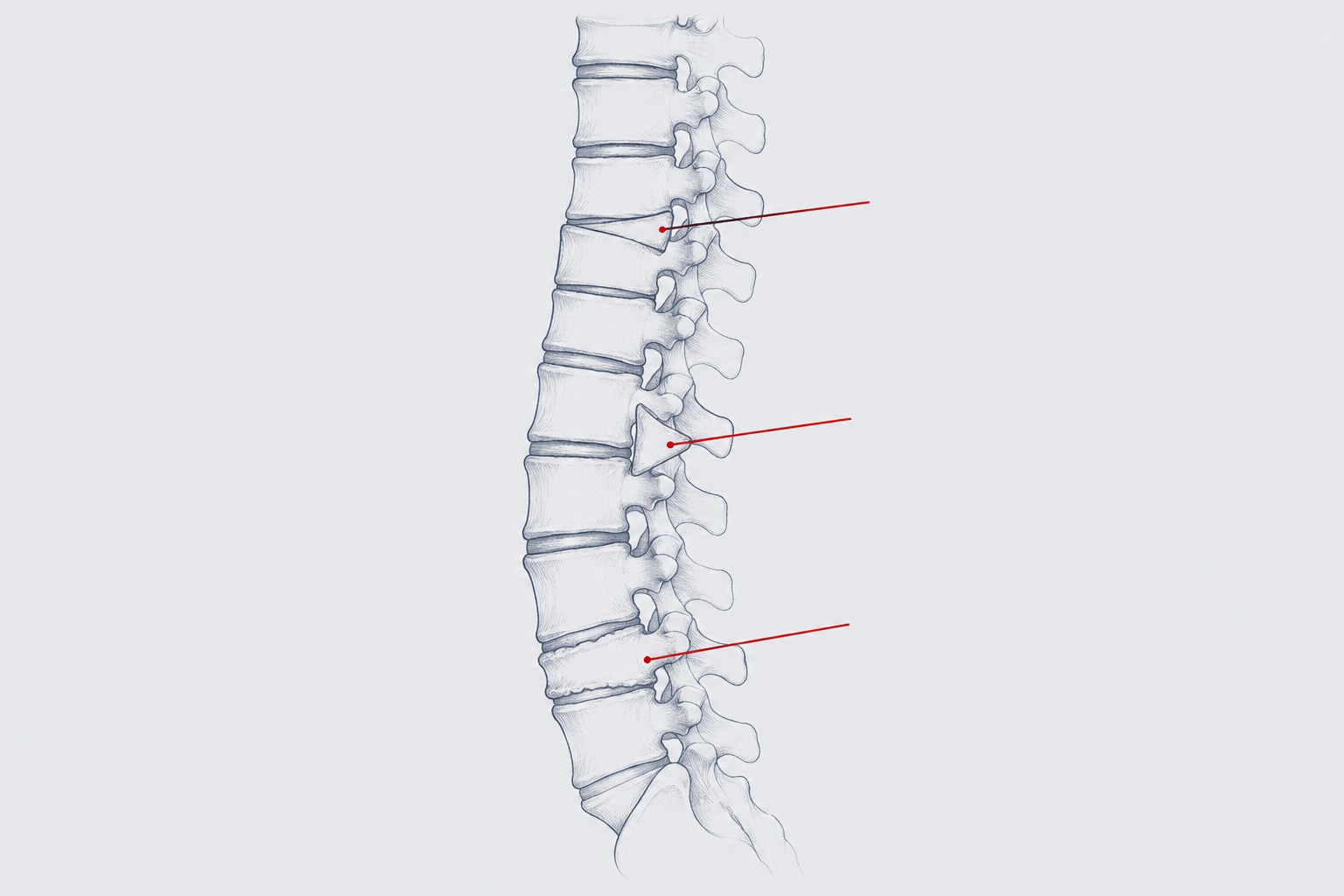
Short answer: in spondylocostal dysostosis the vertebrae are misshapen and often fused, producing a short trunk and curved spine, but the chest usually has enough room to breathe. Intellect is typically normal and most people live into adulthood. The main long-term issues are spine curvature and, in some, restricted chest growth. NORD; GeneReviews via MEDLINE
What the name means.
Spondylocostal dysostosis, abbreviated SCD or SCDO, is also called spondylocostal dysplasia. "Spondylo" means spine and "costal" means ribs. Unlike its cousin STD, where ribs fuse symmetrically at the spine, in SCD the starring problem is the vertebrae themselves: some are wedge-shaped (hemivertebrae), some are fused to their neighbors, and some are missing. The result is a spine that grows crooked and a trunk that stays short.
The wide range within one diagnosis.
SCD is a spectrum. Some people have dramatic spinal curvature visible in childhood and need bracing or spinal fusion surgery; others go through life with a short trunk, mild scoliosis, and little more than a distinctive X-ray. Adults with milder SCD describe ordinary lives: school, work, families of their own. Because the range is wide, your child's specific spinal anatomy matters more than the label.
How it is found.
SCD often surfaces in one of three ways: a prenatal ultrasound notices vertebral or rib anomalies; a chest X-ray taken for something else happens to show fused vertebrae; or a pediatrician notices a short trunk or asymmetric shoulders during growth. Genetic testing can identify the responsible gene in many families, which helps distinguish SCD from STD and clarifies recurrence risk for future children.
What care usually involves.
For most children with SCD, care is orthopedic: monitoring the spine through growth, bracing in some cases, and spinal fusion surgery when curvature progresses. Respiratory issues are less central than in STD, though severe spinal curves can restrict chest growth, so lung function is watched too. Kidney and heart screening sometimes enters the picture, because the same early-development processes that shape the spine shape those organs as well.
Genetics: recessive most often, sometimes dominant.
Most SCD families show autosomal recessive inheritance: both parents are carriers and each pregnancy has about a one-in-four chance. Several genes are known, including MESP2, HES7, LFNG, and DLL3, all part of the Notch signaling pathway that patterns the early embryo. Some families instead show autosomal dominant inheritance, where one changed gene copy causes the condition and each child has a one-in-two chance. Genetic counseling sorts out which pattern is in your family.
Living with SCD.
Adults in patient communities describe short stature, chronic back discomfort for some, and the psychological weight of looking different, alongside careers, relationships, and parenthood. Children benefit from meeting peers: organizations for skeletal growth conditions run family gatherings where kids see adults who share their diagnosis living full lives.
Why prognosis words differ between STD and SCD pages. The two conditions share an old name but not a trajectory. Where STD pages emphasize infant breathing, SCD pages emphasize spine growth over years. If you are unsure which diagnosis applies to your child, start with the name clarification page. GeneReviews; MedlinePlus Genetics