Independent · cited · trilingual
Your child is here. The chest is the project; childhood is the point.
After birth, care concentrates on breathing, chest growth, and spine growth, in that order for most families. This page explains each layer of support and what the surgical path really involves.
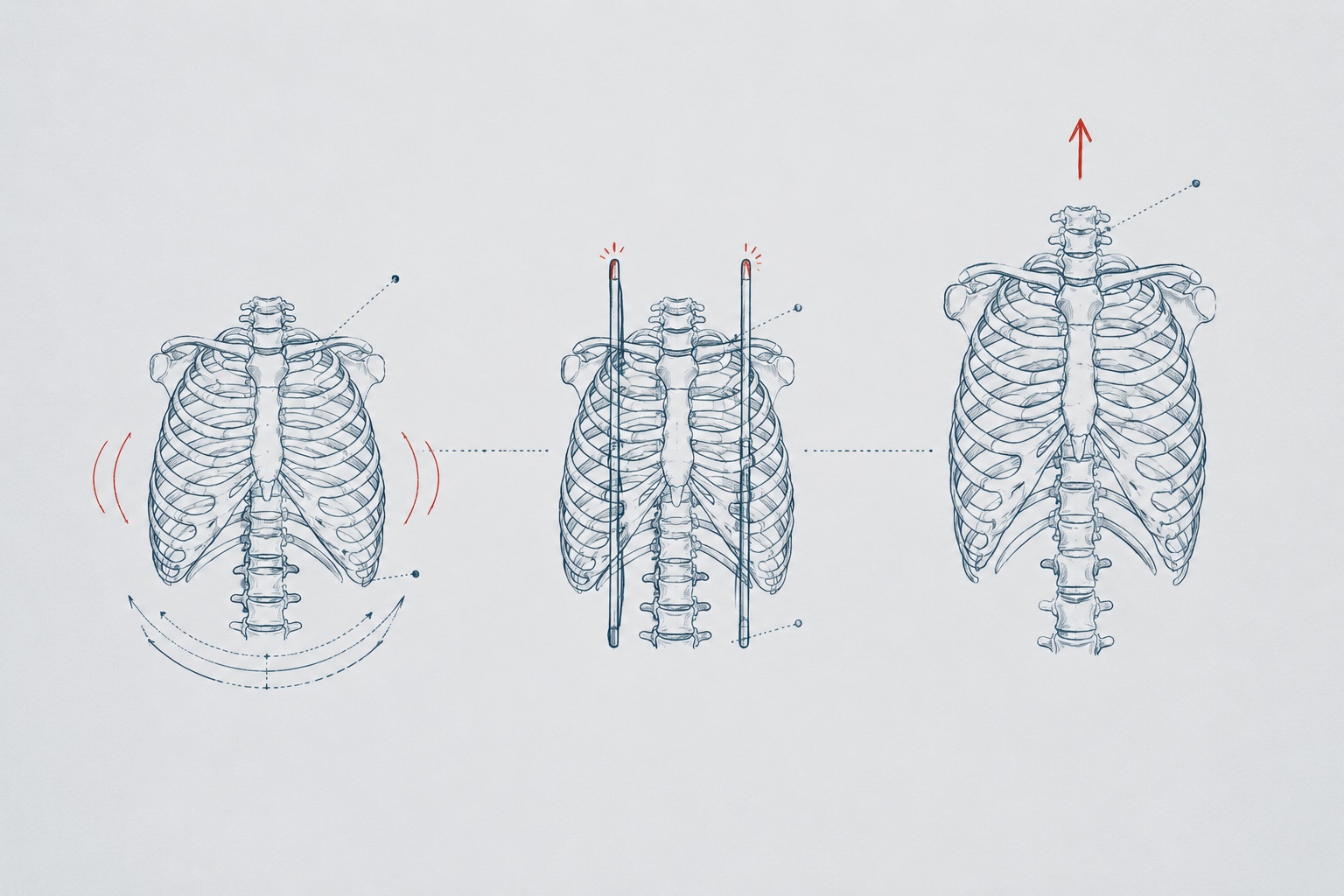
Short answer: care after birth centers on three things: breathing support matched to the child's chest, spine and chest growth watched through childhood, and for some children, surgery to give the lungs room to grow. Children whose intellect is unaffected (typical for both SCD and STD) grow into school, hobbies, and adult lives. NORD; CHOP Thoracic Insufficiency Syndrome Center
The first days: NICU or regular nursery.
Where a newborn starts depends on the chest. Babies with generous chests may stay with their mothers and feed normally. Babies with small, stiff chests may need help: oxygen, CPAP, or in serious cases ventilation. The first days answer a question no scan fully can: how much support does this particular chest actually need.
Breathing support, in plain language.
- Supplemental oxygen: a thin tube brings extra oxygen to the nose. The gentlest level of help.
- CPAP: continuous pressure through small prongs keeps airways and lungs open, reducing the work of breathing.
- Ventilation: a machine breathes for or with the baby through a tube. Serious but often temporary while the care team learns what the chest can do.
- Tracheostomy: in rare long-term cases, a surgical airway in the neck allows home ventilation. Families do manage this, with training and home support.
Thoracic insufficiency syndrome: the phrase to know.
Specialists use "thoracic insufficiency syndrome" (TIS) when the chest cannot support normal breathing or lung growth. It is the main surgical reason in these conditions. Dedicated TIS centers combine orthopedics, pulmonology, and general surgery, and they measure chest volume and lung function over time to decide if and when to intervene.
VEPTR and growth-friendly surgery.
The classic growth-friendly operation places titanium devices (VEPTR) alongside the spine and ribs, expanding the chest. Devices are lengthened in short procedures roughly every six months through childhood, following growth. The goal is lung room: a bigger chest during the years lungs are forming. It is demanding for families, and adults who grew up with the rods describe them as the intervention that made room for their lives.
The multi-specialty calendar.
Expect a schedule that thickens before it thins: orthopedics for spine curvature, pulmonology for lung function, perhaps cardiology and nephrology for screening, nutrition to keep growth on track, and genetics for family planning questions. Older children transition gradually into managing their own appointments, a milestone families mention with pride.
Everyday life in between.
Between appointments there is ordinary childhood, adjusted: many kids with these conditions swim (great for chest mechanics), see physiotherapists for posture and comfort, and handle school sports selectively. Adults in patient communities describe desk careers and physical careers, partners and children of their own, and the accumulated wisdom of a body they know intimately.
Where to find the community. The original Jarcho-Levin foundation ran family support from Puerto Rico for 13 years; today, patient organizations for skeletal growth conditions and thoracic insufficiency host active family groups. Meeting an adult with your child's diagnosis does something no statistic can. Tenleigh's Troops family blog; Little People UK