Independent · cited · trilingual
The ultrasound found something. Here is what happens next.
A referral for fetal ribs and spine findings sends families into unfamiliar territory: targeted scans, new specialists, hard words. This page walks the sequence step by step, with the questions worth writing down.
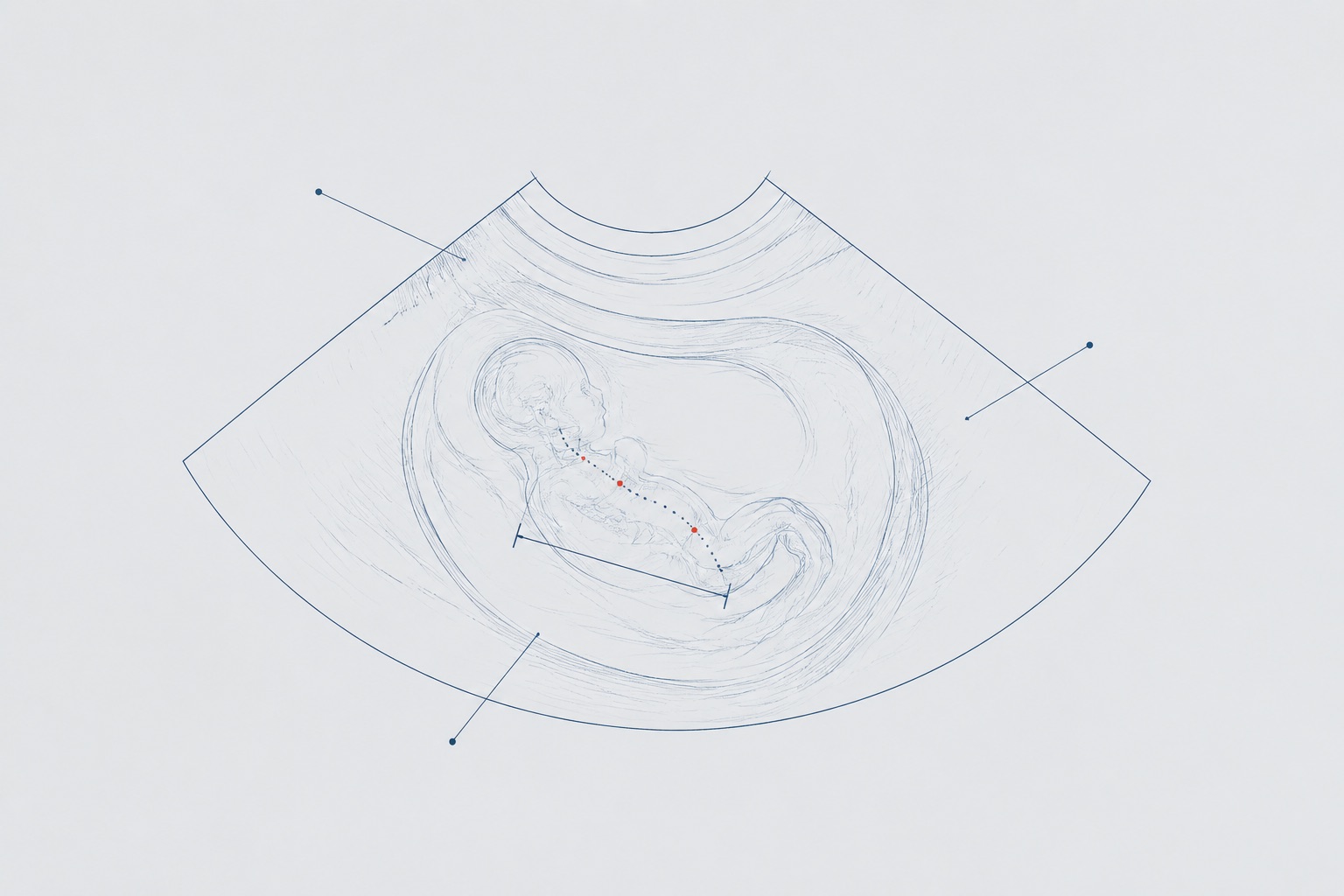
Short answer: a finding of abnormal ribs or vertebrae on ultrasound usually leads to a detailed fetal anatomy scan, a fetal medicine consultation, and sometimes genetic testing. Many families also deliver at a hospital with a Level III/IV neonatal intensive care unit, so that if the newborn needs breathing support it is available in the same building. ISUOG Practice Guidelines; ACOG
The phone call, and the days after.
Most families meet this diagnosis through a routine second-trimester ultrasound. The sonographer pauses over the spine; the radiologist mentions "abnormal ribs" or "vertebral anomalies"; and suddenly a joyful appointment becomes a referral. It is normal to feel the ground shift. The findings that trigger this conversation include ribs that look short, crowded, or fused, vertebrae that are misshapen or irregularly spaced, and a chest that measures small.
What a targeted scan looks for.
The follow-up scan is more detailed, not more frightening. Fetal medicine specialists measure each part of the spine, count and assess the ribs, measure the chest circumference against standard growth curves, and examine the heart, kidneys, and brain, because the same developmental processes shape those organs too. The goal is a picture precise enough to narrow the possibilities.
Questions worth asking at the fetal medicine visit.
- Do the findings look more like a rib fusion problem (STD pattern) or a vertebral shape problem (SCD pattern)?
- Is the chest size tracking normally, small, or severely restricted?
- Is the heart structurally normal on detailed echocardiogram?
- Would genetic testing (amniocentesis or CVS) change our preparation for delivery?
- Where should we deliver, given possible breathing support at birth?
- Can we meet the neonatology team before the due date?
Genetic testing before birth.
Amniocentesis or chorionic villus sampling can test for the genes behind SCD and STD. Some families choose testing because results sharpen the prognosis conversation; others decline and prepare for a range of outcomes at birth. There is no single right choice, and counselors present both paths without pressure. If a family mutation is already known from an older sibling or relative, testing becomes much faster and more precise.
Planning the delivery.
If the chest appears significantly restricted, many fetal medicine teams recommend delivering at a center with a high-level NICU and, where available, a thoracic insufficiency or chest wall program nearby. The birth itself is usually vaginal and uncomplicated; the preparation is about what happens in the first hours, when a small chest sometimes needs immediate respiratory support.
The waiting is the hardest part.
Weeks or months may pass between the finding and birth with no way to sharpen the picture further. Families describe this time as an limbo: shopping for a crib while grieving the pregnancy they imagined. Two things help, according to parents who have been through it: a named point of contact at the fetal medicine center, and limits on late-night searching. The published literature describes worst-case series; your child is not a series.
On searching for images. Searching the old name returns X-rays of the most severe archived cases, often from decades ago. They are not a preview of your child. If you need to see what the spectrum looks like, the terminology page explains what "crab-like chest" actually means. Parent community reports; ISUOG