Preprint · not a journal paper · checked 2026-10-10
TBX6 holds two fates that families already see together.
On 30 July 2026 a Guangzhou group posted a preprint: in human organoids followed for about fifty days, taking TBX6 away stops both the somite and the intermediate mesoderm, the tissue kidneys come from. It is a mechanism paper sitting on a server, not a new gene and not a new test.
The spine and the kidney are not two unrelated findings.
Some children with a spondylocostal pattern also have a kidney that is missing, small, or misplaced. Clinics have known the pairing for years. What they have not had is a human map of the hours when those two tissues are still the same group of cells. Yuanxin Liao, Cheng Chen, Guangdun Peng and their colleagues at the Guangzhou Institutes of Biomedicine and Health built that map in a dish, and they put it on bioRxiv on 30 July 2026. The DOI is 10.64898/2026.07.29.741448. It has not been through a journal. Treat every sentence below as a preprint, which means other groups have not yet had to try to break it.
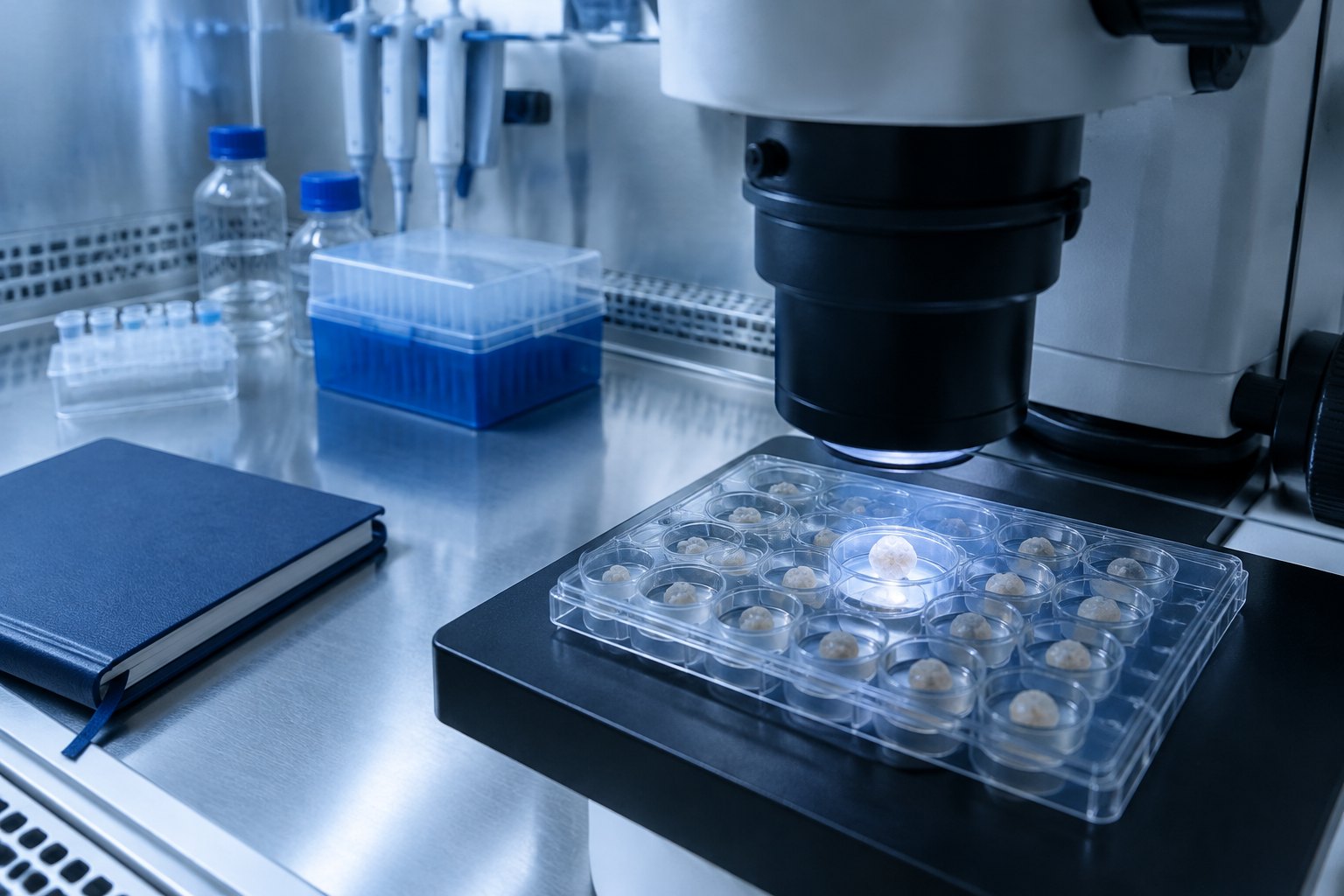
They grew neuromesoderm organoids from human pluripotent stem cells and followed them for about fifty days. Into that system they put a CRISPR lineage tracer, so a cell and its descendants carry a scar that later sequencing can read, and they paired that with single-cell RNA and single-cell chromatin profiles. The question is genealogical. Which of these tissues still had a common parent after the embryo had already decided to make a trunk.
What they say TBX6 is doing.
The abstract's claim is specific. Intermediate mesoderm and paraxial mesoderm, the somite's parent tissue, both come from one presomitic progenitor downstream of the neuromesoderm. Lateral plate mesoderm, the tissue that will make things like limb-bud mesoderm and the lining of the body wall, splits away earlier. When they remove TBX6, both the somite path and the intermediate-mesoderm path fail. The presomitic cells stall as progenitors. The programs that would have matured the intermediate mesoderm do not turn on. The authors' own last sentence ties that to congenital conditions that affect the spine and the kidney together. They are not claiming a new diagnosis. They are claiming a place in the lineage where one gene can touch both.
They also trace neural-crest paths out of the same neuromesoderm, and they say some molecular signs appear before the crest has split off. That is a second result in the same preprint. It is not why a family with a rib film and a renal ultrasound would open this page, so it stays in this paragraph and does not become a claim about the nervous system of any child.
TBX6 was already on the list. This does not add it.
Spondylocostal dysostosis type 5, OMIM 122600, has been a TBX6 diagnosis since Wu and colleagues published it in the New England Journal of Medicine in 2015. The inheritance they described is compound, and it is easy to misread. A child is affected when one copy of TBX6 is a null, a copy that makes no working protein, and the other copy carries a common weak haplotype, three variants inherited together: rs2289292, rs3809624, and rs3809627. A null allele by itself, in their account, was not enough. That is clinical genetics that panels already know how to look for. A 2026 organoid paper does not move TBX6 onto the list, because it was never off it. Our genetics page says the same thing in shorter form.
What the preprint can change, if it holds, is the sentence a clinician uses when a spine film and a kidney ultrasound are both abnormal and the panel already says TBX6. The pairing stops looking like two bad draws. It looks like one stalled progenitor. That is a mechanism. It is not a reason to order a new test, and it is not a reason to reinterpret a negative panel. The preprint used CRISPR to delete the gene in a dish. It did not sequence a new cohort of children.
What a family should not do with a PDF from a preprint server.
Do not treat the date on bioRxiv as the date a guideline changed. Do not let anyone sell a "TBX6 organoid test." If your child's panel is negative and someone suggests this paper means the gene was missed, it does not: a mechanism study cannot find a variant a sequencing lab did not see. If the panel is positive, the recurrence arithmetic on the genetics page is unchanged, because that arithmetic comes from how the alleles were inherited, not from how an organoid behaved. The DMRT2 note from September is a different kind of paper: two children, a journal, a gene added to a panel. This one is the other kind. Read it as a map of a decision the embryo makes, and wait to see whether a journal, and another lab, can keep the map.
Sources. Liao, Chen, Li, Wang, Wang, Zhu, Yao, Peng. Single-cell lineage tracing of human neuromesoderm organoids reveals TBX6-mediated posterior mesoderm fate diversification. bioRxiv, posted 30 July 2026. DOI 10.64898/2026.07.29.741448. This is a preprint. Wu et al., TBX6 null variants and a common hypomorphic allele in congenital scoliosis, New England Journal of Medicine, 2015. PMID 25564734. OMIM 122600 (SCDO5). bioRxiv 30 Jul 2026; NEJM 2015; OMIM